

I was really into homebrewing beer and things like that in the late 2000s. So, what I was originally going to do was open a brewery—and it was getting crowded, that scene. In hindsight, I’m glad I didn’t.
I had hired a guy, and we were working late one day. We were talking, and he told me he had vacuum-distilled some cheap wine and aged it on wood chips, and it turned into this amazing brandy. And a little light went off in my head. I thought, “What would it taste like if I vacuum-distilled a beer?”
The first beer I did was a mango-habanero double IPA—trying to emulate the Founders Mango Magnifico, which was my favorite beer at the time. And I was just blown away by how fresh it tasted. I could taste the hops and the mango and the habanero that I used with it. That just triggered me to switch things up and learn about distilling and to maybe try to innovate in that space.
We were getting going by late 2019 and early 2020. That should have been a great year, but obviously COVID hit, and it f*&%#@ up all the plans. We weren’t really getting any sales because everything had closed down, so we lost all our momentum. The next couple of years, we were struggling to get that momentum back, and we didn’t really start getting it back until 2023.
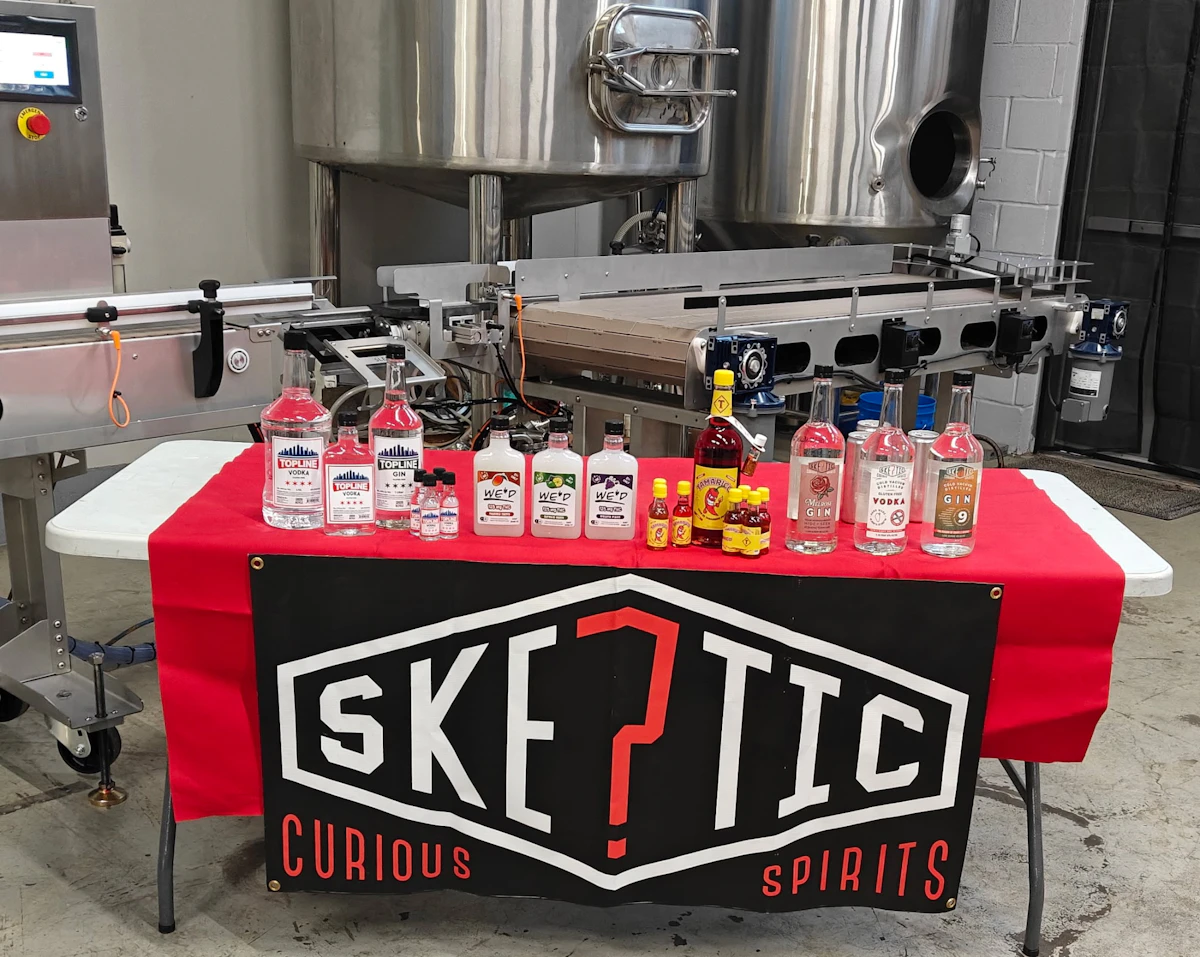
Moving into Copacking and Contract Production
It started way back in late 2019. I did my first white label of a vodka for a now-defunct brand. I haven’t really needed to seek out the opportunities—it’s more or less referrals or people who Googled us.
I’d probably benefit from doing more social media and online stuff, but you only have so much time in a day. It really started picking up roughly a year ago. We had done some projects; a lot of the network that I’ve built over the years is where a lot of it’s coming from. Where we excel is figuring out how to do it and being very adaptive.
Everything that we are copacking, we are actually blending up for the customer, but some of it is stuff that we’ll formulate for them and produce turnkey for them. Some of it, they’re providing the packaging and things like that.
The best way to do it is the more turnkey way. When people are sending you all of their different bottles and ingredients and things like that, that’s a struggle to keep separated—especially granular ingredients, such as sugar or dried citric acid, or flavors and things. You have to segregate that and store them separately from everything else.
We’re doing energy drinks for one client. We’re doing coconut water, a vodka RTD—just a regular vodka high-proof RTD. We’re doing lots of different THC beverages, both in bottles and in cans. We’re not doing any sodas or anything, but we have another client who wants to do functional beverages. They want to pivot from THC to mushroom, amino-acid type functional beverages. We’ll probably be doing some of those soon.
It’s kind of all over the map. I think it’s good to be diversified in what you’re offering because everything alcoholic that you make has an excise tax tied to it that you’re going to have to pay when it leaves.
Outfitting for Copacking
We can do pretty much any beverage that doesn’t require pasteurization—that’s another piece of equipment that eventually I’d like to get.
The more capability you have, the wider variety of clients you can attract. You might be able to offer something that some large copacker with all the equipment can’t because they’re doing very large runs. But if you’re going to start out in this, you’re going to want to do smaller runs because those will just get ignored by the bigger contract houses. Or they won’t be able to give them the personal connection and communication that you will.
We treat every product that we’re packaging for someone like it’s our own, so we’re going to give it the same level of care. If you’re in one of those big houses, it’s just a project—they’re just going to slam it through. If something’s wrong—you know, if the lot code or expiration date isn’t printed properly— they don’t really care; they need to move product through fast. We’ll obsess over some of those things that maybe nobody cares about, but we think it’s important.
You’re going to already have a lot of the equipment that you’ll need. Most distilleries are going to have a boiler; definitely the cooling, air capacity, compressed air, tank sizes. You want some refrigeration for some of the ingredients that people will be using.
You need some level of filtration. I have a cartridge filter that works really well. But I also use a lot of tri-clamp gaskets with filter screens on them. I’ll stage bigger pore size and smaller, and that actually works phenomenally just for particulate filtering before bottling. That’ll even filter out residual carbon dust from when I carbon-filter the vodka.
You need bottling equipment, bottle date coders. [Skeptic has both a standard bottling line and a line designed for 50-milliliter bottles.] We just started canning. Breweries are good at doing that because they typically already have that kind of equipment. Someone could use a mobile canner, but that’s going to raise your costs overall. We have a couple of canned vodka RTD projects we’re doing that are still beverages, so we need a nitrogen doser for that. I had to go and finance that. So, I’ve got a bunch of equipment that I’m financing.
There’s a lot of equipment at auction these days. If someone has the money, it’s a great time to pick up extra tanks—the more tanks, the merrier, if you’ve got room for them. It just gives you more flexibility. One of the problems I have is we don’t have a ton of tanks for a wide variety of sizes.
There’s always something new you need.
Specific Challenges from a Diverse Range
For the THC hemp drinks, that might be going away in November, or it might not. But you have to get a hemp-processing license from the state. Illinois has a department for that. It’s not that expensive.
Some people might require you to get a third-party CGMP (Current Good Manufacturing Practice) certification, which is a shit-ton of paperwork, and we’re working toward that. It’s a lot of documents you have to basically create, and then you pay someone to audit you.
You’ll find that most products are a challenge the first time because you don’t know what you’re getting into. With kava, specifically, that is not water-soluble. There are certain powder-type ingredients that are more hydrophobic. So that one and some of the other emulsifiers had to be blended in with glycerin, which is by itself extremely thick and viscous. So, that one was a challenge.
For another product, we had to do a staged heating process. The first group of ingredients had to be blended in at 140°F (60°C) for several hours, and then we had to reduce it to 120°F (49°C), then blend in liquid ingredients and hold it for a period of time. That’s a bit of a challenge.
THC largely comes in from the major emulsion suppliers. They package it in a water-soluble emulsion, so it’s become very easy to add to beverages. The emulsions do make it cloudy, though.
People have an idea of what they want to sell something for, so they have a budget for what it’s going to cost, but you have to make money doing this. Sometimes, you have to be able to say no to some of these projects.
The Advantage of Flexibility
The dream is always to come up with your own brands and launch them, and they become successful. Obviously, you make the most money doing it that way.
But you’ve invested all this money in this equipment to make spirits. There’s no way you’re going to fill that with just your own brands right away because that just takes so long. And unless you’re coming in with millions and millions of dollars—and even then, it might not be enough—there’s no guarantee.
But if you have all this equipment, you can make money off that equipment, and employ people, and have it running and working for you by helping other people bring their dream beverages to market.
It’s a really nice way to do it because really your only cost is your overhead and your labor. You’re not investing in the marketing, trying to go out and sell it to distributors and consumers, doing tastings. You’re not having to take on any of that. And you’re going to get paid before the product leaves your dock.
We’ve edited this text for length and clarity.