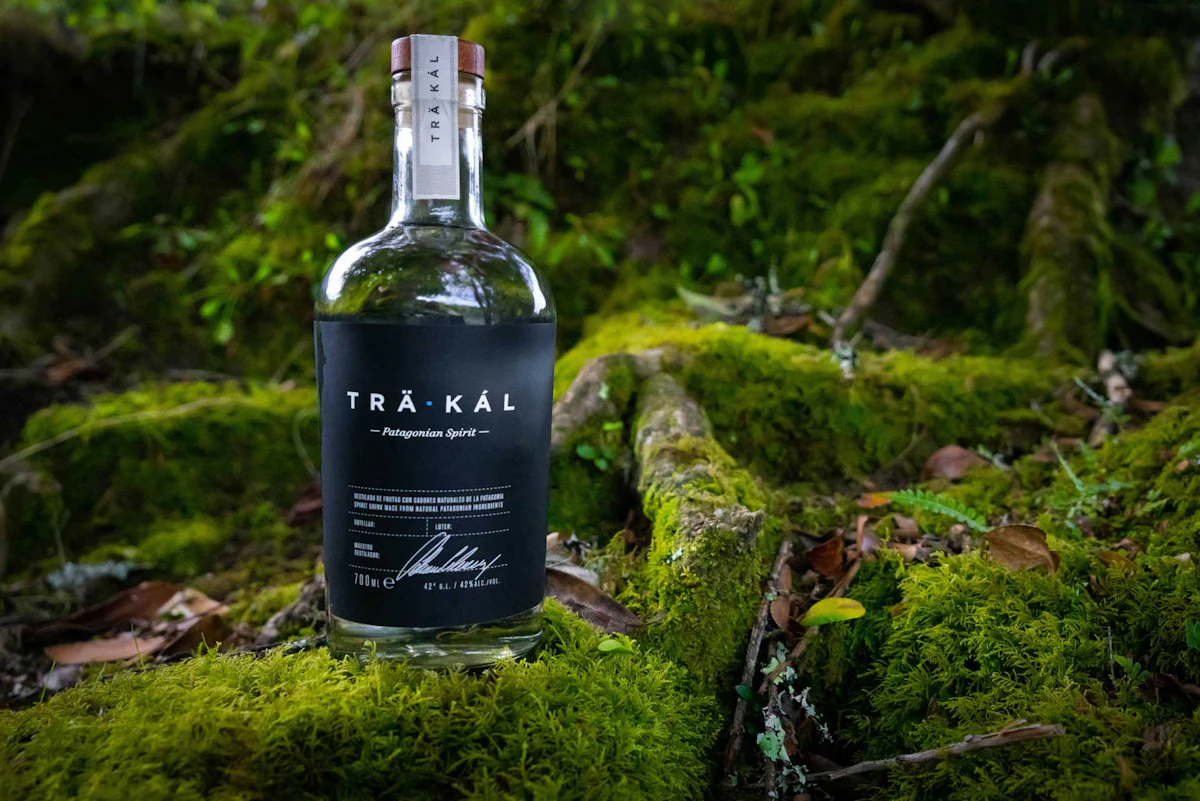
Categories don’t just provide a way to understand spirits through regionality, ingredients, process, and tradition. They also lend distillers a roadmap with clear guidelines—even if they’re sometimes open to interpretation.
It’s a noteworthy innovation, then, when a distiller creates not only a new spirit but an entirely new category. When Sebastian Gomez launched Träkál in 2017, he established a spirit that had never before existed and one that aims to capture the flavors of Patagonia.
Träkál begins with a base of fermented pears and crab apples that is then distilled with Patagonian botanicals and berries. In its eight years of existence, it has become an under-the-radar favorite among bartenders, helping to connect those who try it to flavors of a region that hasn’t been widely known for spirits.
Yet putting Patagonia on the beverage-alcohol map was exactly what Gomez set out to do.
A Rallying Cry
Patagonia spreads across the southernmost tip of South America, including parts of Argentina and Chile in its diversity of landscapes that range from the Andes Mountains to deserts to glaciers.
Gomez is a native Argentine who went to England for business school, eventually getting into finance and working for what would become Diageo. There, he fell in love with spirits, wine, and beer—especially the stories of individual distilleries, wineries, and breweries, and the subtle nuances of region, culture, and craft that distinguished each producer.
Somewhere along the way—as he was traveling to learn about those producers and managing markets in the Caribbean and Central America—Gomez says he “realized there was a bottle missing. There was nothing from Patagonia. A bar might have everything from water from Fiji to gin from Poland and whiskey from Japan, but there was nothing representing Patagonia. It wasn’t part of the distiller’s map.”
Gomez left Diageo to strike out on his own. Within a few years, he’d sold everything he owned to head to Patagonia with nothing but a couple of suitcases—not even a recipe for the spirit he was there to invent.
“I just knew the culture, the quality of the water, and the uniqueness of the fruits and herbs there,” he says. “With that, I knew I could make interesting booze.”
Working with the region’s indigenous Huilliche people, Gomez furthered his knowledge of local ingredients. Part of the broader Mapuche group, the Huilliche people also helped with the name: Trä means “courage” or “valor,” and kál means “to act.” Together, it’s a sort of let’s do this rallying cry.
The Components and Process
Patagonia isn’t an agricultural region, which Gomez says is an advantage.
“It’s why the water there is so great,” he says. “There’s no nitrogen or pesticides getting pumped into the water table.”
Fruit grows in abundance, including apples, pears, and many different types of berries. The chicha of Patagonia isn’t made from corn, but instead from various local fruits. At first, Gomez tried distilling this chicha, but the result was oxidized and dark with “a lot of funky oils.”
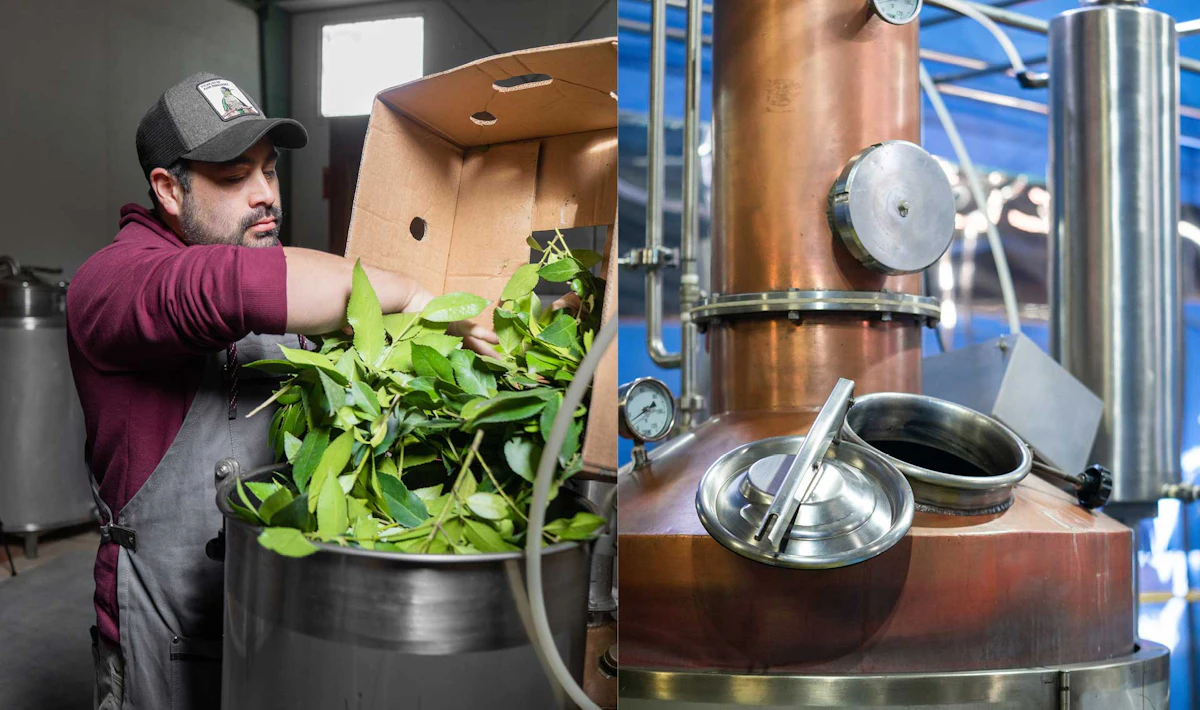
Searching for a clearer, sweeter fruit base, Gomez landed on distilling a more straightforward blend of fermented apples, crab apples, and pears. On the second distillation, he adds three varieties of native berries: murta, maqui, and sauco. Murta has flavors similar to strawberry, pineapple, and guava; maqui is more comparable to blackberry and raspberry; and sauco has an earthy black-currant quality.
He adds those berries in the form of a concentrate made by a nearby company, which cooks them down into a mix. He also makes an essential-oil blend from native herbs, which he adds for the third and final distillation. Tepa, laurel, mint, water mint, canelo, and paramela contribute notes of fresh lime, nutmeg, and floral notes. Every 2,000 or 3,000 liters (500 or 800 gallons) of Träkál require two to three kilograms (four to seven pounds) of each herb, he says.
For the fruits, Gomez buys sacks from locals—often their leftovers from making chicha. He also buys the herbs they forage. “We want to behave as corporate citizens,” he says. “We only want the stuff that’s already available. We don’t require huge quantities—we’re never going to damage crops.”
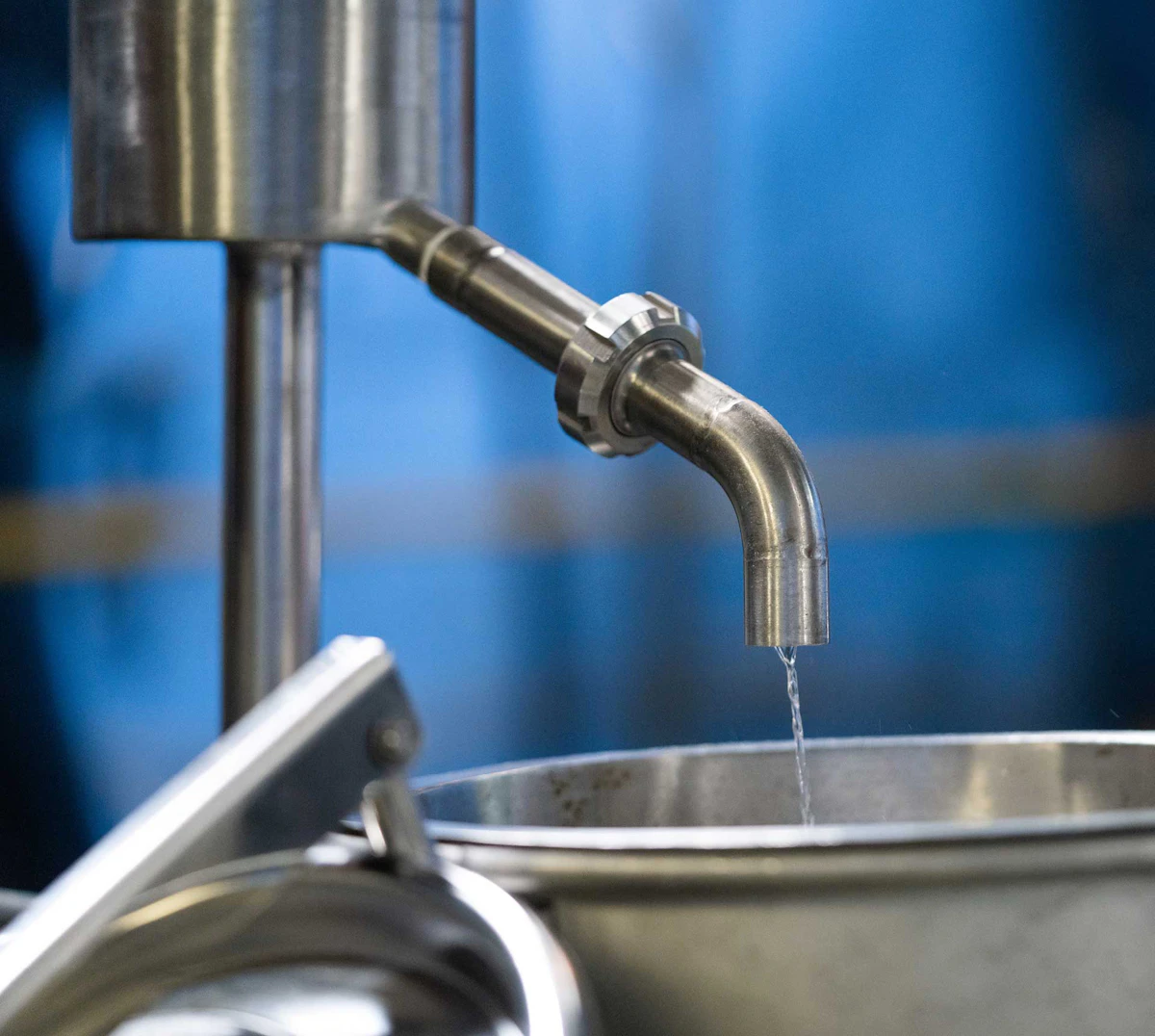
Gomez uses five stills. The first two are 1,500-liter (400-gallon) stainless steel with 5.4-meter (17.7-foot) columns; he uses these to distill the fermented fruit juice. The juice goes in at about 5 percent ABV and comes off the stills at nearly 90 percent. For the second distillation, with the berry concentrate, Gomez uses a pot with a tall, plateless column; as the alcohol travels a greater distance, it develops into a more refined distillate.
Glycerol from the berries helps homogenize the distillate’s different elements. Gomez says that primes the distillate for an easier, more thorough fusion with the essential oil on the third distillation. He distills at relatively low temperatures with motorized spoons that continuously stir the spirit, creating a smooth finish that’s still rich with intense, recognizable fruit-and-herb flavors.
The distillate comes off its last still at about 104 proof, which is then diluted down to 84. The entire process takes almost eight hours; after this, the spirit rests in 5,000-liter (1,320-gallon) tanks to more fully homogenize before bottling.
Currently, Gomez says he’s preparing to launch an aged expression of Träkál that will incorporate yet another Patagonian element—wood, which the local people often use for cooking, adding another distinctive local flavor.
Launching a New Category
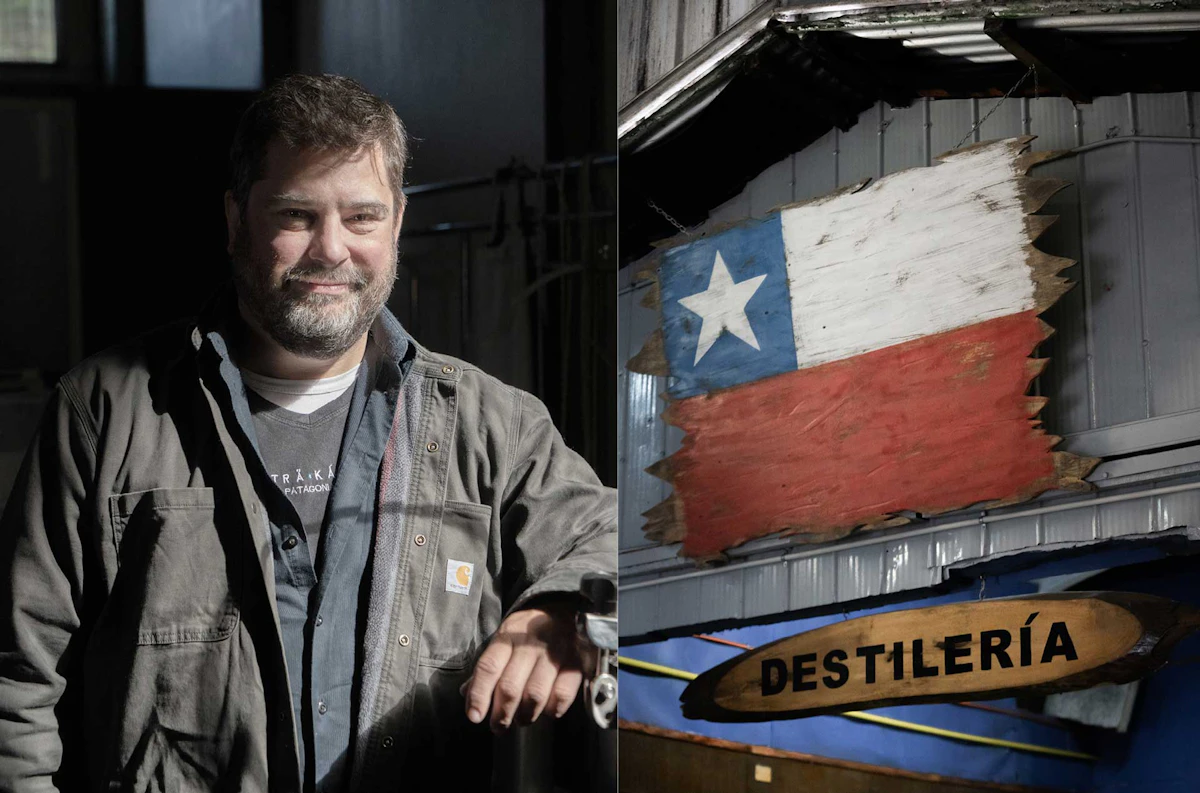
Once Gomez had locked down his recipe, he recruited friend and business partner Ben Long as a cofounder, to assist in a simultaneous launch both in Patagonia and the United States. They began in Denver.
The challenge to get TTB approval for a spirit in a category that didn’t yet exist may sound daunting. However, Long says the agency was receptive and understanding.
“We were convinced they were going to call us ‘brandy,’ since we technically have a brandy base with the apples and pears,” he says. “But we just explained our process, and they came back with a description: ‘Spirit distilled from apple and pear, infused with botanicals and berries.’ Because of where we’re making this, how we’re making it, and what we’re making it with, the TTB gave us our own unique descriptor.”
Träkál is currently available in 20 states; Long says their top five markets are New Orleans, Denver, Chicago, Boston, and Minneapolis. It was tough at first to navigate consumer education and know where to begin with a new kind of spirit, but bartenders’ immediate appreciation for such a unique product was a boon for the brand.
Gomez and Long have leaned into that, regularly welcoming bartenders and beverage directors to Patagonia for a more hands-on experience in the region and with its ingredients. Equipped with that understanding, bartenders across the United States have helped to evangelize what’s so special about this Patagonia-in-a-bottle spirit.
Even as Träkál wins new fans, Gomez and Long are still learning and tweaking as they expand and prepare to bring their new, aged expression to market. They recently rebranded the spirit to balance minimalism with need-to-know facts on the label, adding a sense of place and storytelling via an illustration of a Patagonian volcano. It helps to make the bottle pop on a shelf or back bar.
As Träkál moves forward, the partners also aim to engage and inform consumers without overwhelming them—another sort of balance, setting a compelling example for how to forge a new path based on an uncompromisingly flavor-forward expression of Patagonia.