
Micronesia
From The Oxford Companion to Spirits & Cocktails
is home to just one operating distillery, Guam’s Own, on the Micronesian island of that name. Distilling is therefore rather a lonely proposition.
Despite the incredible technological advances in nearly all aspects of modern life and commerce, getting much-needed raw base materials for distilling to remote island locations in the South Pacific is practically as slow and costly as ever. Couple this fact with the high cost of obtaining or creating potable water and you have a powerful duo of inherent challenges to distilling spirits. In recent decades, brewing operations on Saipan, Palau, and the Marshall Islands have shuttered as a result of these challenges.
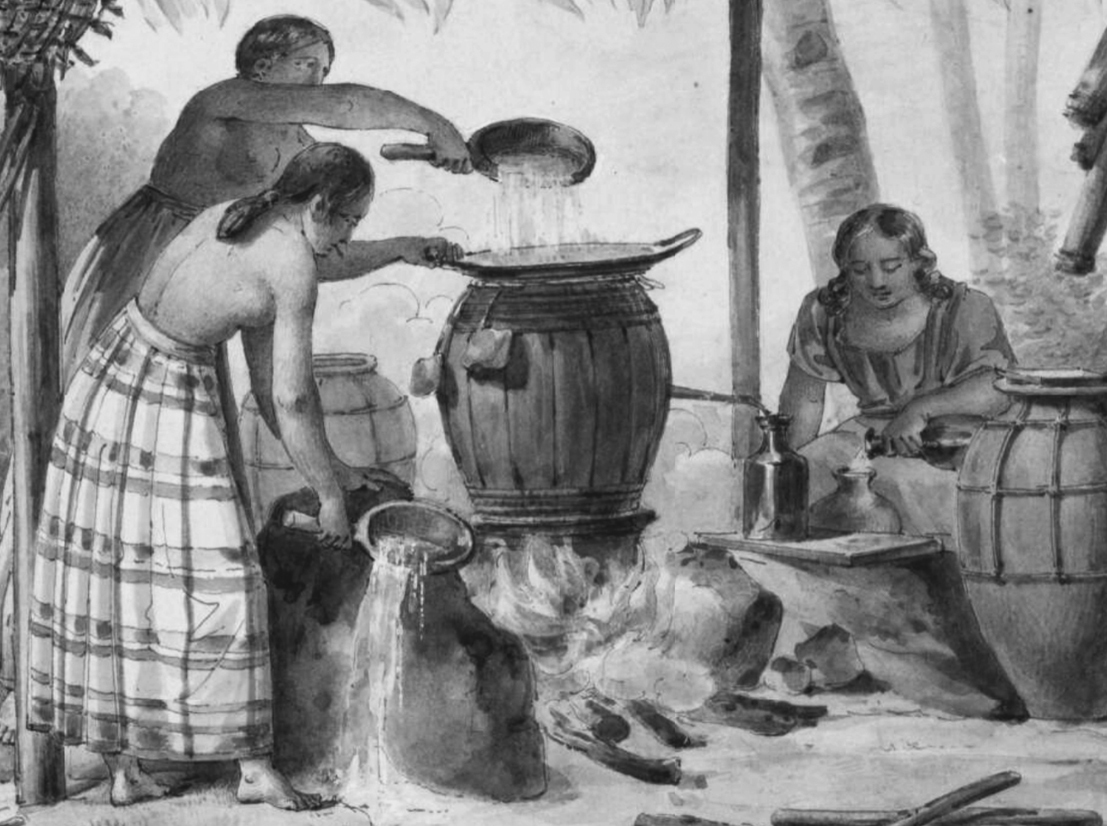
Micronesians had no history of alcohol production or use prior to the arrival of the Spanish in the mid-sixteenth century. Islanders in some parts of Micronesia embraced the narcotic effects of kava, the nonalcoholic drink made from the root of the Piper methysticum. From the middle 1500s to the later 1700s Guam and other islands were important layovers for the Manila galleons traversing the Pacific. Spanish sailors introduced wine and other alcoholic beverages to Micronesia, and Micronesians, especially in Guam, eventually began to make fermented varieties of sugar-cane juice and coconut palm sap, which they sold to the Spanish as a necessary provision on their long voyages. Micronesians eventually began distilling these fermented drinks, and a French expedition lead by Louis Freycinet in the 1810s found, and illustrated, a Chinese-style pot still being used by the native Chamorro people in Guam in the 1830s. See
In Guam, the main spirit produced was “aguayente,” or “agi,” generally distilled from tuba, or palm wine, although it was sometimes based on cane juice. When the Americans gained control of Guam following the Spanish-American War, they attempted to stamp out the production of “devil water.” Christian missionaries led these temperance efforts. Distilling on a commercial scale would not occur until the years in between World War I and II.
Guam’s Own Distillery, founded in 2009, is locally owned and operated. Guam’s Own makes a wide array of products including mango vodka, whisky, a trio of rums, and an aguayente, which is an homage to the style of sugar-cane-based spirit once made on colonial Guam. By all accounts, the rums made at Guam’s Own are the most successful in Guam in terms of both sales and consumer preference. In the first years of operation, Guam’s Own relied heavily on locally grown sugar-cane juice, but these plantations and processing facilities have since closed. Although they make efforts to use local materials, sugar-cane juice, molasses, and other base materials for distilling must be sourced from other nearby islands. Guam’s Own products are not exported and are only available on Guam.
De Freycinet, Louis. Voyage autour du monde, vol. 2. Paris: 1829.
Jackson, John. “Feejean Islands.” In Journal of a Cruise among the Islands of the Western Pacific, by John Elphinstone Erskine, 470. London: John Murray, 1853.
By: Sean Ludford
!Micronesia Primary Image
The Chinese-style internal condensation pot still observed by Louis-Claude de Freycinet in Guam in 1819. Source: Wondrich Collection.See
This definition is from The Oxford Companion to Spirits & Cocktails, edited by David Wondrich (Editor-in-Chief) and Noah Rothbaum (Associate Editor).